The Meaning of a Lighthouse
Or why water mocks the wealth of nations
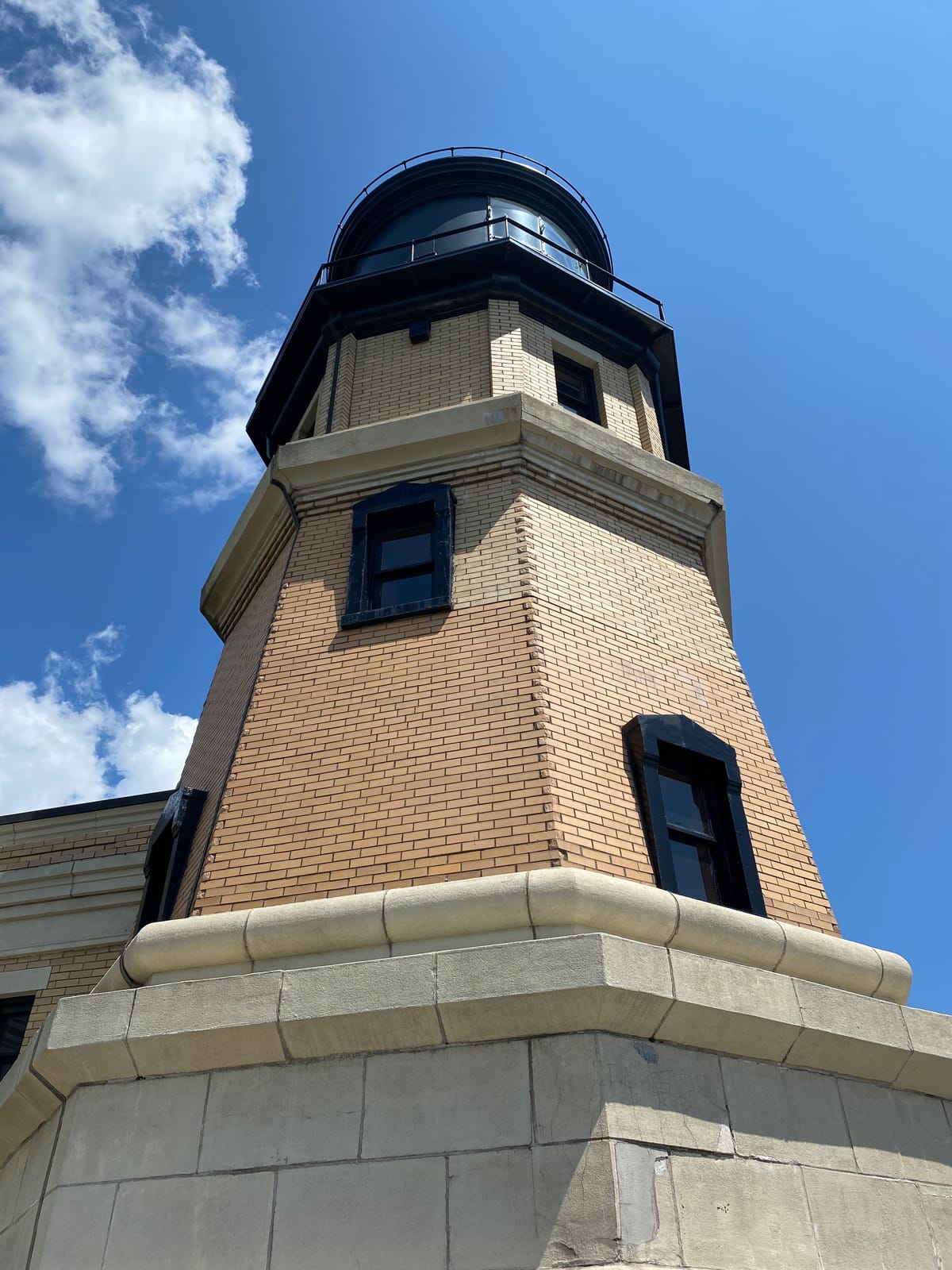
Popping into your inbox with a different kind of article—longer, more researched, though still bringing a lot of the personal reflection that you’re here for. Below I discuss a recent trip to Split Rock and how it completely shifted the way I think about water and Western nautical history.
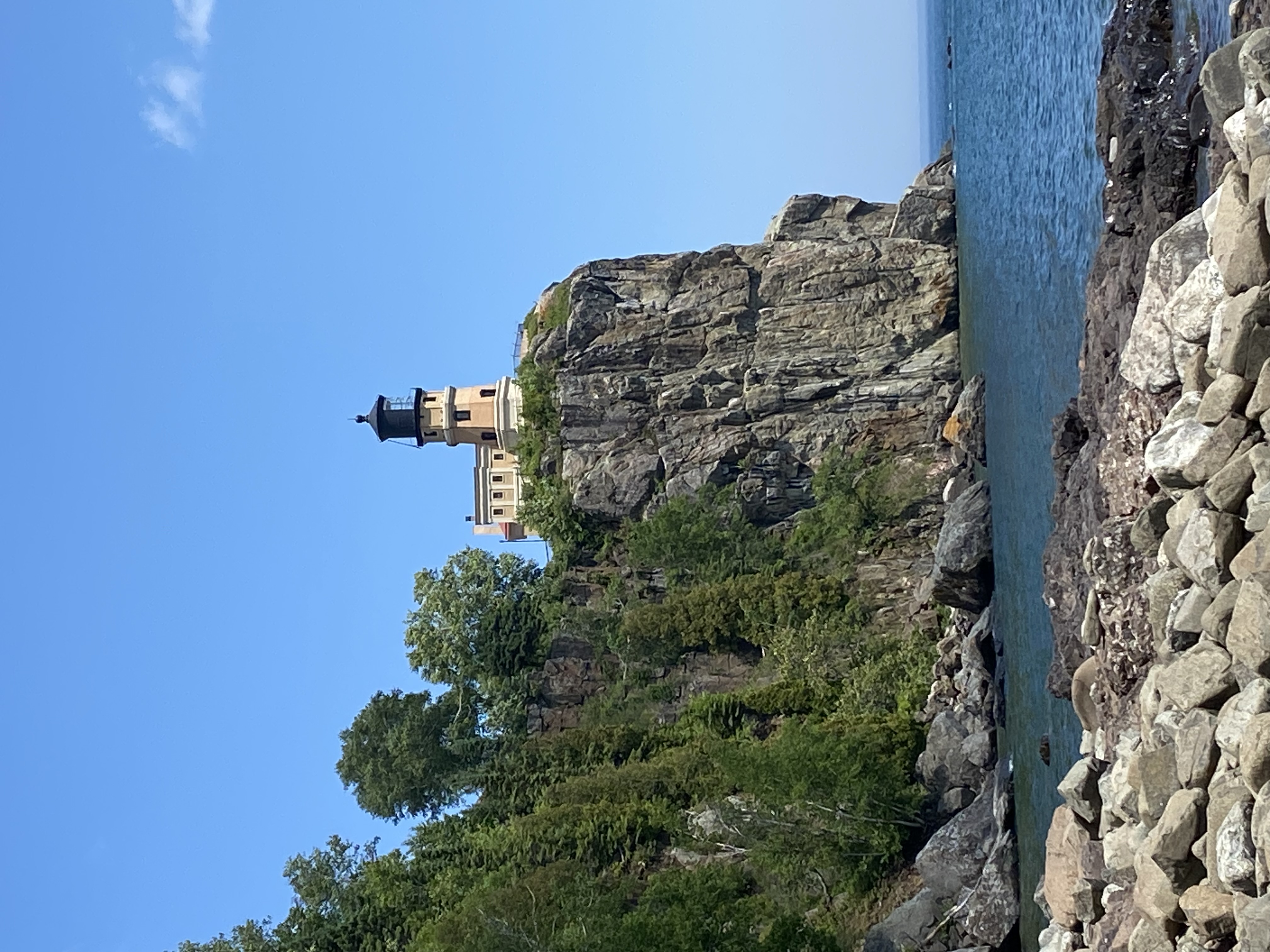
I recently took a day trip to Split Rock Lighthouse in order to indulge my amateur interest in maritime and nautical history. Such interest began with a research project about the Lost Franklin Expedition during pandemic Zoom school and then turned into a true special interest when I watched Titanic for the first time in college. Of course, both of these doomed journeys are filled with a dizzying amount of melodrama that would hook anyone—the isolation of the North Atlantic, the hubris of luxury and state-of-the-art tech, the tragedy of their endings—but its exactly the kind of romance an unsettled and wandering writer hopes for. The expanse of the horizon with the closed environment of a boat is, speaking in terms of technical craft here, perfect for any novelist. And I’m not the only one who thinks that. Western nautical fiction stretches as far back as Homer’s Odyssey, but you’ve also got Shakespeare, Jules Verne, Patrick O’Brian, and your secretly nautical fictions in sci-fi adventure like Star Trek. And besides, who hasn’t been tortured by Moby Dick by some literature teacher at some point in their education?
Anyways, since I was going to be in Minnesota for longer than previously thought, I figured now would be a good time to visit the North Shore. I had never seen Lake Superior up close, and that seemed like an oversight by this point. It was a painfully perfect day—seventy degrees and the noxious air from the wild fires in late June had finally blown on. While rubbernecking my way through Duluth, in awe of the industrial draw-bridges and docks, the freighters chugging away, and eventually staring up at Split Rock Lighthouse from the pebble beaches below, I found myself meditating on the force of water. It was unfathomable to me, enraptured by the beautiful verdigris and Prussian blue waves that were mirror clear lapping against my fingers, that any shore as striking as this could ever get angry enough to sink a boat like the Edmund Fitzgerald.
But of course that was the whole impetus behind the construction of Split Rock Lighthouse in the first place, and without the access from Highway 61, the entire effort was a marvel. The supports for the tram that hauled building supplies to the top of the cliff, while crumbling and useless now, still stand. Keepers still wind up the lighthouse like a grandfather clock—I watched one do so. It took time, intention, engineering, and human sweat to build and to maintain, and it stands immaculately. Like most marvelous efforts, it was expensive to do, but not more expensive than the lost iron ore extracted from newly stolen Indigenous land all used to support the US Industrial Revolution.
I realized a couple of things from this excursion: 1) I didn’t respect water enough. 2) That water is the one thing that can give Uncle Sam, or any extractive empire, a run for his money.
The Ocean Will Eat What Makes You
There’s been pant-shittingly apocalyptic news about our oceans lately. Swaths of fish washing up on shorelines. Orcas attacking boats. Temperatures spiking at near hot tub levels. People drowning off the coast of Greece fleeing from homes that have been destabilized and made inhospitable by Western imperialism. And yet amidst all that, it was Ocean Gate that grabbed the most press time, and thusly, grabbed the most of our attention. I spent countless hours that week scrolling through twitter discourse (RIP Elon took you too early from us all) about whether those inside were still alive or not. I suspected against my own very very dim hopes that they had died, and I suspect that most reasonable or even cynical people did too. Even a beginner’s lesson in the dangers of submarine pressure differentials paint a very clear picture of their fates.
What was interesting to me was not the melodrama of some rich people and arrogant adventurers who wanted to traipse around a maritime graveyard with nothing to offer besides their own amusement, but our public contentions about wealth. Surely these rich people knew better. Surely that much money goes to something good and safe. But oh surely they will survive. But surely the Coast Guard…and so on until NewsNation’s oxygen timer ran out. Everyone laughed at the Logitech controller over the Camping World lights, regardless of the fact that that the former equipment was probably the only standard feature aboard the doomed submersible. People argued whether it was reasonable to care or conversely express antipathy about billionaires dying in a myriad of horrific ways. We moved far from trying to understand the technology or the particular dangers of sub-nautical travel that the Titan perished to or the impossible odds of those trying to rescue them in favor of pontificating on the hubris of Stockton Rush and the paper trail that so clearly predicted his downfall. All this money, all this class matters particularly because it didn’t matter exactly when it should have. It didn’t save the people who were, in social imagination, never supposed to die in water in the first place.
It bears mentioning that our tools for determining such things are explicitly raced and classed. Compare the miniscule coverage of the Greek boat carrying refugees from Palestine, Syria, Egypt, and Pakistan, which sank a week before the Titan sub. Or about the ways American and Western European xenophobia treated Syrian refugees fled via the Mediterranean circa 2015. Or even consider the role of the Atlantic in forging US racial identity, from the Middle Passage to Ellis Island. There are obviously more examples than I could possibly list here. The point I’m trying to make is that for centuries, water has been the prism where the Western world tried to assert, and classify people into, specific social slots that it wrongly treats as self-evident or naturally emergent.
It’s this kind of dialectic that pops up again and again when talking about disastrous wrecks and icebound expeditions. Questions that challenge assumptions about the way Western hierarchies ought to operate. Beyond its immense tragedy, the Titanic was notable because most of its survivors were women, an uncommon occurrence because the practice of women and children first was less an actual protocol and more a late 19th century ideal of moral respectability. So when women survivors talked about how the boat split and the stern rose up in the air, a misogynist world awaiting them on shore refused to believe them. Their testimony, and the women themselves, would only be vindicated when the wreck was discovered in 1985, just over seventy years after the Titanic sunk (in the video below, survivor Eva Hart discusses this around the 8:30 mark). I have no doubt that this misogyny stymied efforts to understand why the Titanic sank for decades.
And to bring it back to the wreck that really started all of this for me, the fate of the Franklin Expedition challenged the might of the British Empire in the mid-19th century and soured the British public’s appetite for polar exploration. Similarly to the Titanic, the general consensus at the time was that the Erebus and Terror were the height of British engineering and emblematic of the power of its Crown. The Illustrated London News published a full page article in May of 1845 celebrating the launch of the expedition and lauding the technological advancements that would ensure its success, like new screw propeller blades that could be detached and reattached at will, heated berths, and well-considered provisions.
Of course, when the expedition conspicuously lost contact with the Admiralty just a few years later, authorities denied anything was wrong—how could it have gone wrong? Captain Franklin himself was a decorated explorer, there was no way he could have gotten lost in the remaining “unexplored” (scare quotes because the Inuit super duper lived there and still do to this day) 300 square miles that needed to be filled on a map. Surely the Northwest Passage would be there, Franklin will be a hero, and new routes of trade will fill the British Empire’s still hungry coffers. Such was the expressed sentiment of the Crown and Admiralty when the public started getting worried. Jane Franklin, the titular Captain’s wife, had to campaign for three wholeass years before the Admiralty did anything about it.
While various search and rescue missions pieced together the fate of the expedition from the paramount testimony offered by the Inuit who witnessed a great deal of what had happened, the actual Erebus and Terror weren’t located until 2014 and 2016 respectively. Clearly by that point everyone had died—starvation, malnutrition, lead poisoning or zinc deficiency, and likely cannibalism too. There was nothing the British could do to save their arctic heroes, and when the Northwest Passage was found, it ended up being completely useless for trade, too dangerous for even seasoned officers like Franklin to manage, which meant merchant ships traveling through was a non-starter. It was, in all respects, and abject failure. None of this is mentioned in the Stan Rogers’ ballad of course.
In any case, disasters like the ones I’ve mentioned don’t just arise from a cascade of engineering and protocol failures, but from social systemic ones too. Why were there too few lifeboats on the Titanic? Because the ship was unsinkable. Why did the Franklin Expedition descend into cannibalism and why did it take literal centuries for the wreckage to be found? Because the Admiralty had spared no expense. Why was the Titan sub made of carbon fiber instead of titanium? Well, in this case, the spared expenses of a daredevil capitalist would prove that innovation would bring about a new age of deep-sea exploration. All of these assumptions and stories, dashed to pieces, and remembered for an all too different exceptionality.
Water is where the fundamentals of social identity that sort us—race, gender, class, nation-ness, empire, and more—are reflected back at us and destroyed. And because we can’t seem to understand that water will have the last word on such matters, we keep getting shocked when rich Westerners die, we keep getting shocked when there are things that we just can’t do, we keep getting shocked when even our most protracted symbols of privilege and ease aren’t protected either. That was what I learned at Split Rock that day, not necessarily that water can kill you, but that it will render all this bullshit useless.
How I feel about this lesson is something I’m still chewing through. In some respects I find this exciting, that there might be a kind of inevitable surrender inherit to defeating our worst societal sins. All of it will crumble and is crumbling and we get to make something better out of it because we really have no choice in the matter, not if we want to avoid catastrophe. In other ways though it’s less a promise of liberation and much more a dire warning of our imbalanced ways of living, a visceral life or death calculus for millions that will still embody all our hierarchies. Who am I to sit here and pontificate about a spiritual experience I had when I am among the least likely to be affected by rising tides? So vacillating between hope and fear, all I know is that the latter is a world I don’t find livable, and I am adamant that our capital will not save us, the same way it didn’t for Franklin, for the Titanic, for the Titan sub, and many more, and our great error is that we (hyper-object society-sized “we”) continue to expect it to. There must be a more just world on the other side of all this strife, and maybe the water will show us the way.
Because I am not liar and a fool, below are my works referenced that I have otherwise not linked in this newsletter. Forgive the poor formatting, Substack does not permit MLA margins:
"ANOTHER VISIT TO SIR JOHN FRANKLIN IN THE POLAR REGIONS." Preston Chronicle, 13 Apr. 1850. British Library Newspapers, link.gale.com/apps/doc/Y3207433185/BNCN?u=mnadwl&sid=BNCN&xid=7c233db2. Accessed 17 Feb. 2021.
"The Arctic Expedition." Illustrated London News, 6 May 1848, p. 297. The Illustrated London News Historical Archive, 1842-2003, link.gale.com/apps/doc/HN3100019280/ILN?u=mnadwl&sid=ILN&xid=5443cd3e. Accessed 18 Feb. 2021.
"Departure of the 'Erebus' and 'Terror' on the Arctic Expedition." Illustrated London News, 24 May 1845, p. 328. The Illustrated London News Historical Archive, 1842-2003, link.gale.com/apps/doc/HN3100440564/ILN?u=mnadwl&sid=ILN&xid=f07122ef. Accessed 18 Feb. 2021.
"Expedition in Search of Sir John Franklin." Illustrated London News, 13 May 1848, p. 318. The Illustrated London News Historical Archive, 1842-2003, link.gale.com/apps/doc/HN3100019349/ILN?u=mnadwl&sid=ILN&xid=eb5f3ab8. Accessed 18 Feb. 2021.
"Naval and Military Intelligence." Illustrated London News, 6 Oct. 1849, p. 227. The Illustrated London News Historical Archive, 1842-2003, link.gale.com/apps/doc/HN3100023075/ILN?u=mnadwl&sid=ILN&xid=3b9093bc. Accessed 18 Feb. 2021.