Ode to Minnesota
I had intended to start off the new year reflecting on last year's lessons, challenges, and triumphs. But, like so many folks, find myself reeling from the murder of Renee Nicole Good. Somehow I've always found myself far away from Minnesota when such cruelties occur. It's not comparable to the grief or chaos Twin Cities locals are experiencing, but distance from a place you love while knowing its suffering smarts in its own way. Through that distance, I'd like to give you this offering—not to diminish any righteous anger, or grief, or exhaustion, but to give you space to pull it as close as possible. Below is a small passage I prepared for a reading a few months ago, a time when I was deeply homesick for Minnesota, the first time I was ever truly homesick in my life, and needed to coach my way through it. I hope this passage reminds you of all the lovely things Minnesota has to offer its people and the rest of the world, and that this is a place worthy of fierce protection.
Imagine, if you will, that there's a door in front of you. You stand on the stoop. An oak tree shakes its boughs above you, leaves rolling in the wind like the scruffy mane of a wolf. Summer—and summer's wind still reminds you that winter is never far away. Soon those green leaves, rolling in Summer's wind, will turn to fire, alight the buttes along the great lake. Fire and ice collide on the pebbled shores , and the ghost of shipwrecks lost in the gales of November breach in warning. This is a wild land you have lived in, and you found in it a treasured host that nourished you.
And there you stand on the stoop. Humble concrete steps before a wooden door and a window, covered by a lacy curtain on the inside. You press your face against the glass, nose smushed against the old rippled plane. Shadows rove back and forth. Your friends—you just said goodbye a minute ago.
You're grown now, which partially means you understand people who are not you continue to exist outside of you. But this kind of empathy isn't easy. You cannot demand the shape of you to linger in their lives. Part of you wishes to rush back inside and grab a knife to cut a hole in their soul to make sure there's always room. Something about the blood and sorrow on your hands vindicates the missing you didn't expect to feel. You never will know if they'll favor the jagged edges of goodbye. Time is water, in the end, and will lap away the jagged edges of goodbye.
The water in the lake will rush upon the pebbled shores, break down the rough rock, granite-cut by glaciers, and grind it down to something small. The saying goes that you can't take it with you, but this neglects the important things. Like the tea you shared on cold days, snow piled two feet high, to warm the very friends on the other side of the door.
You were so proud of your selection—lemon, turmeric, ginger peach, lavender chamomile, and mint. Everyone had their mug and tea of choice, gathering to moan about their day as soon as they came in from the cold. One wrapped in a blanket, another huddling a heating pad, and you leaning against the radiator.
You survived on rituals like these. You think maybe you can take that with you, tuck it into your pocket, small as a pebble. Your friends taught you a lot—how you didn't have to beg, grovel on the ground, explain yourself. There were only the rituals of creating warmth out of nothing but the common bond of weathering the cold.
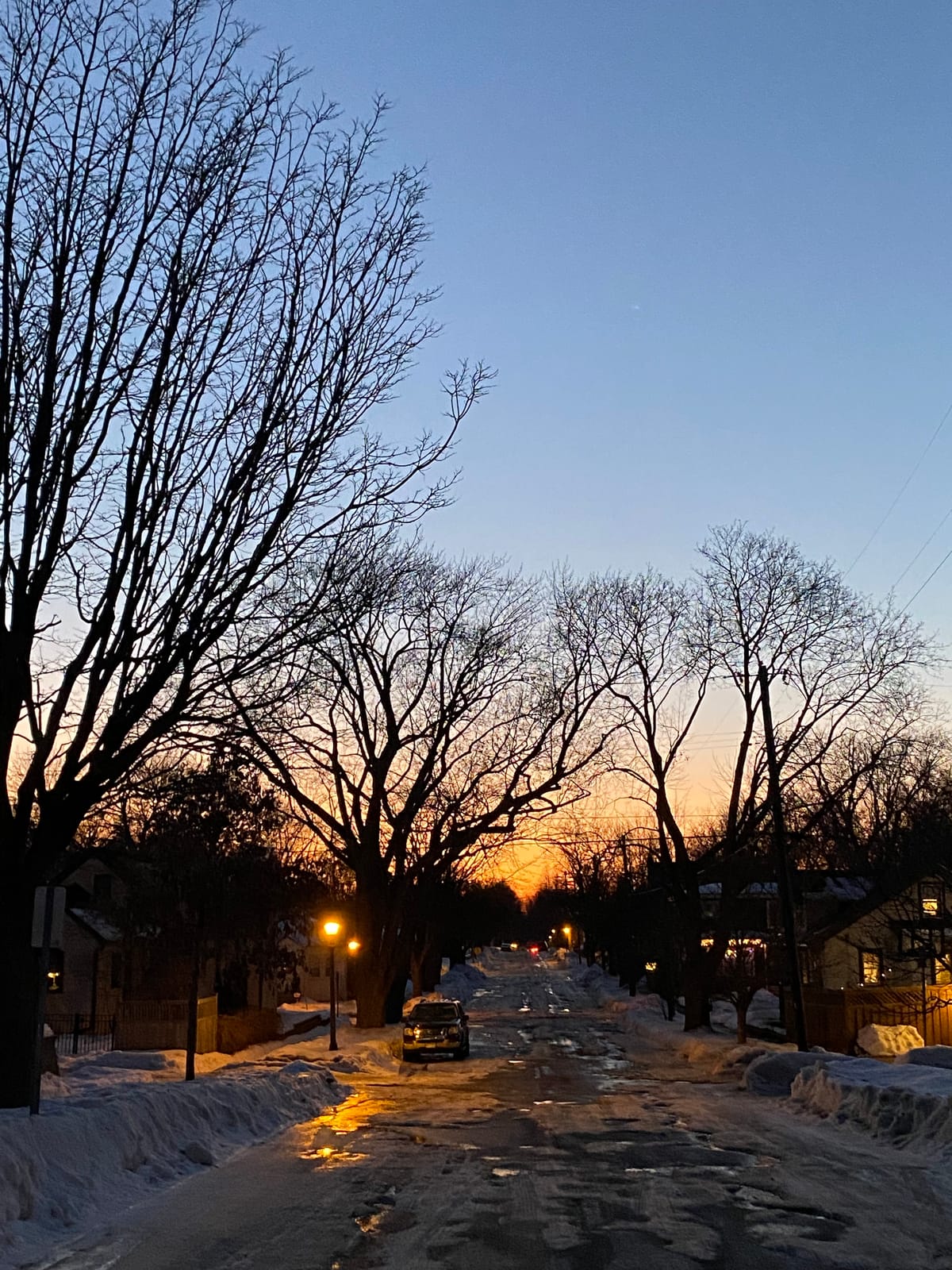
Cold. Always cold. Half your time in the wild land was cold. Cold enough the snot in your nose froze, your eyes grew whorls of hoarfrost, and your back teeth shrunk, and ached. You were not always happy. The sun rose low and left early, and you could go weeks at a time without seeing it at all. You sometimes wondered if you were dead already. But then the next day—because there's always a next day—the snow is fresh and there are no clouds in the sky—you learned that it was a lie, a terrible lie that you couldn't see snowflakes with a naked eye. You caught them on your mittens and counted all the fractal spokes and spires. Some were as big as your pinky finger. And suddenly you weren't dead, but a child again, agape in wonder at the blinding snowshine around you.
Now, you can't take snowflakes with you. Eventually the snow melts. The tulip house on 25th street blooms. The ice on the lake cracks in thunderous bellows. When spring comes there is no more need for tea or for rituals. Time is water and washes upon everything, even the seasons in a year.
It is summer now, and fall is coming. Your friends inside are laughing, which hurts. Remember though—you are the one doing the leaving. You don't want to leave but the door—a discreet and gentle twist on the handle before it can't turn at all. You cannot enter again. You have already said goodbye. Maybe you haven't learned about faith yet—faith that your friends laugh because they sense you haven't left the stoop. They think you're still in the house with them. Laughing.
Summer's rolling wind gathers you up and kisses your cheek. Have faith, it says, and guides you down the stoop in a moment of quiet courage. Have faith—this wild land is never far. You can always come back while there's time. You must make time to re-seek this wild land.