How To Survive Tyranny
Over the past few months, all indications pointed to my father’s cancer treatment failing. Donald Trump was also elected as the next president of the United States. While my father’s condition has stabilized greatly (and only recently), below are a series of commonplace vignettes I wrote to stay grounded. They speak to each other, but reach no conclusion. I hope they are cathartic for you as much as they were for me write.
My father’s cancer treatment is failing, and I oddly feel relieved. It’s there, quiet amist a speechless miasma of anger, bitterness, and sadness. Relief because years of ambiguity are coming to a close, and relief because now there are no excuses to avoid the important things. For the first time since my father was diagnosed with cancer, I can anticipate where all this business is going. I can prepare. I can decide how I want to spend my time with him, to create new joys, hash out old pains, and make of life what gets taken for granted when its taken as a given. This — my father dying of cancer — was always going to be the ending. This — life is a promise of death — was always true, and much of my own pain has come from being yanked away from that by the banal drudgery of end stage capitalism.
I am determined to make good use of this remaining time not because I am wise, but because I am scared—scared of many things, but chiefly of regret. That question of regret really is how do I want to live / how do I want to die?
— — —
I wonder to what extent political tyranny is a problem of fatherhood perverted. The latin root of so many jingoisms — patriotism, patriarchy, and so on — is closely related to that of “father” — pater. Sylvia Plath wrote in her poem “Daddy” that “Every woman adores a Fascist” (38). We call white colonizers and enslavers the founding fathers of America. Trump supporters cried out “daddy’s home!” When their man stepped out on stage. These are just a handful of examples but in each one there is not an expression of guiding, protecting, providing, but one of absolute totalizing control. Implicit in patriotism is an unwavering dedication to the patriarch. A woman submits to her fascist father. A criminal treasonous abusive sexist racist former president returns to the highest office in the land to give “the country a good spanking.” In short, I speak and you obey.
— — —
When I ask other people about my father, I’ve been told all manner of stories, many of which painted him as a curious soul who didn’t think much of consequences. For example, as a young boy, he wanted to know what it was like to fly, so he grabbed an umbrella and jumped off the roof of his one story house and into the front hedges.
I get my curiosity from him, and my penchant for mischief, and my tendencies towards exacting technicality and arguing passionately about it. I could list off so many stories, but I hesitate to, because it feels like eulogizing someone who is still alive. I admire him most because he is my father.
He was the first person I came out to in high school. We were tipsy and making baklava for Christmas, following the family recipe, methodically washing melted butter over sheets of phyllo dough and sprinkling layers of a haphazard mixture of pistachios, walnuts, and pecans. When I asked him to keep it a secret, he did, without question.
He stood in between me and a bear hiking once. It was a mama bear and we had inadvertently stumbled in between her and her cubs. He shoved me behind him when the bear growled at us, and did not admonish me for running away.
He went against the grain of what makes a good man long before it was in vogue. He went to therapy (back when it was still shameful to speak about) to break the cycle of abuse and to learn to manage his temper. He often cooks and cleans around the house.
My relationship with my father is not out of a Sylvia Plath poem, he is far from a fascist, far from a tyrant. But the cancer certainly has been tyrannical.
— — —
The titular trio of Dostoevsky’s The Brothers Karamazov were not so lucky to have as a father as good as mine. As far as fictional tyrants go, Fyodor Karamazov ranks among the worst offenders. The legacy of his neglect, physical abuse, and emotional torment have extensive impacts on each of the brothers, each one desperate to escape the cycle of violence in their own particular way yet somehow doomed to repeat it. Each brother has their own paradigm of breaking away from their father’s legacy, and they clash often. No portion of the novel exemplifies this better than The Grand Inquisitor chapter.
In it, Ivan, the middle brother, entreats Alyosha, the youngest and a priest, to give him an answer as to why God allows the physical abuse of children. He considers it one of humanity’s greatest evils, but symptomatic of an irreconcilable flaw in God’s design of humanity. The existence of suffering, particularly that of children, proves that humanity is incapable of shouldering the moral responsibilities that accompany free will, and the greatest insult to Ivan is that God forgives this sin anyway;
“Men themselves are to blame…they were given paradise, they wanted freedom, and stole fire from heaven…all I know is that there is suffering and that there are none guilty” (Dostoevsky, 201).
Ivan understands God’s forgiveness not as redemption that comes from great and painful change, but of absolution which requires no effort at all. Implicitly, he does not want his father to be absolved for abusing him, and he does not want to support any kind of machination that would do so. To him it is the height of injustice, because of its dismissal of the material consequences of such pain. Guilt must exist in order for retribution to exist as well.
All this prefaces Ivan’s Grand Inquisitor story which details something of a plagiaristic mish-mash of Pontious Pilate confronting Jesus with Promethean mythology. The world has been united by an elite cabal of Christian-ish believers who have taken on the burden of knowing the nature of good and evil and suffering for humanity’s sins. The Grand Inquisitor, having finally caught the man whom he suspects is Christ, explains how the latter is irrelevant in the face of this new world;
“I tell Thee that man is tormented by no greater anxiety than to find someone quickly to whom he can hand over that gift of freedom with which this ill-fated being is born. But only one who can appease their conscience can take over their freedom. In bread there was offered Thee an invincible banner; give bread, and man will worship Thee, for nothing is more certain than bread. But if someone else gains possession of his conscience—oh! Then he will cast away Thy bread and follow after him who has ensnared his conscience” (Dostoevsky 221).
To distill a lot of Orthodox Christian theology way too much, “bread” refers to the temptation of Jesus Christ in gethsemane where Satan promised to give him power over mankind through bread, and generally symbolizes the lowly, mortal plane of concerns. Sins of the flesh kinda deal. It’s a metaphor. We all have our bread, so to speak. Ivan’s bread is getting even with his father for the heinous physical abuse he endured at his hand.
And he argues that people deserve their bread, freedom and absolution for our impulses towards fear and exacting it on others. Isn’t that what any authoritarian promises? Let me be the martyr, the guilty one, and in doing so you will be guilty of nothing.
— — —
What do you do when you watch someone you love succumb to sickness? Cancer does not always move slowly. Some are gone within months. But time stretches and bends in odd ways when contending with terminal illnesses. I have felt frozen at seventeen years old for the past six years, and this arrested development sometimes prevents me from imagining a future. All I have and have ever had is right here in the present, with me. Time stretches and then it collapses, racing faster than you can comprehend. One day someone you love is, relatively speaking, fine. The next day you’re trying to count the days themselves.
I have been dealing with the resolution of one tyranny and the advent of another more or less the same. Some boozy movie nights shared with fresh chocolate chip cookies and friends. Plenty of humor. Occasional bouts of disarming anger at righteous moments and at ridiculously small ones. Pondering the banality of evil while wanting to refuse it and wondering how and where I helped make it normal and how I can stop. Making bouquets of exceptionally orange fall leaves to put in my favorite blue bottle to display on the dining room table. Hugs from the elite few I’ve granted that privilege to. Sleeping. Eating. Repeating.
—— —
The first time I read The Brothers Karamazov, I found Ivan’s poem hopelessly compelling. It was one of those gut twisting moments where you find yourself rejecting something on moral grounds but flounder to find any riposte that feels as convincing. Ivan’s Inquisitor was wrong because he had to be, but I struggled to find any way to show it. The world is awful. Mankind does and continues to do awful things and there are days where I feel we are too weak-willed to stop. It is hard to witness the world churn on with deadly force, to exact racism and genocide on people, on human beings, and feel anything other than bitterness.
The novel does offer a counter argument to Ivan’s chapter, and while it contains one of my favorite passages, I’ve newfound respect for it. Alyosha Karamazov (the priest guy), too, has a crisis of faith almost immediately after Ivan shares his story. One of his own mentors, Father Zosima, passes away. The other monks of the monastery speak ill of him once he is dead and his body begins to decompose, which Alyosha interprets as a flagrant interpretation of eternal life. Muddled with doubts about the true nature of Father Zosima, the promise of heaven, and unable to shake what Ivan has just spoken to him about, Alyosha prays by Father Zosima’s coffin and receives a vision of Christ’s first miracle, turning water into wine, with an ever increasing table.
What happens next? Barring some miracle, I spend the end of the year wisely with my family. There will be a few more scans and blood tests to clarify exactly what will happen next, but eventually I will bury my father. Despite the pain of it, it is a privilege to be able to seriously consider taking significant time away from my professional life to spend time with him.
What happens next? Barring something major, Trump will be inagurated January 20th and will leverage his power to hurt people. Despite the pain, there is relative privilege in being angry and upset and not fearing for survival. Not everyone is so lucky to be insulated in this way.
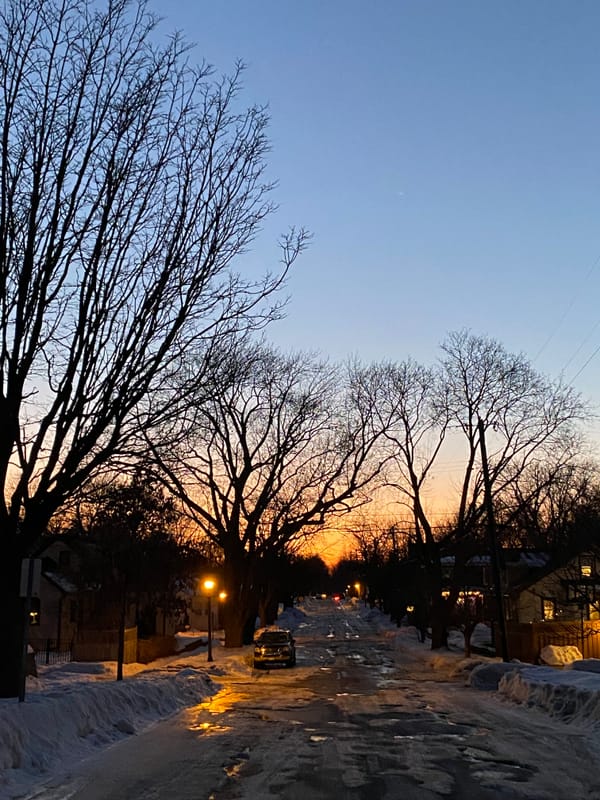
What happens next? I think about the epigraph to The Brothers Karamazov, “except a corn of wheat fall into the ground and die, it abideth alone; but if it die, it bringeth forth much fruit.” I think about Alyosha’s functional rebuttal to Ivan, that Jesus’ first miracle was turning water into wine to multiply mankind’s joy. I think about my grief and how its a reflection of how lucky and fortunate I have been to have a doting father. I think how excising cancer is arduous and brutal, and how kindness and beauty must be so potent if even the magic of winter’s first snow kissing my cheeks is enough to make me smile in spite of all of it.
Even when my father is six feet under, I will continue to want to make him proud by doing good. What do I have to give? How can I protect other people the same way my dad protected me from a bear? Can my grief be generous and joyful too and make me fearless? Can I use it to help others be fearless too?
The only thing worth obeying is my own heart.
Further Reading:
On Tyranny, Timothy Snyder (the illustrated version is incredible)
The Brothers Karamazov, Fyodor Dostoevsky
“Carrion Comfort,” Gerard Manley Hopkins
“The Wall,” Pink Floyd
“Dirty Computer,” Janelle Monae
“Wayfaring Stranger,” Rhiannon Giddens
Thanks for reading Call Me Discontented! Subscribe for free to receive new posts and support my work.