BOOK REVIEW: The Will of the Many
Or getting lost in the pyramid
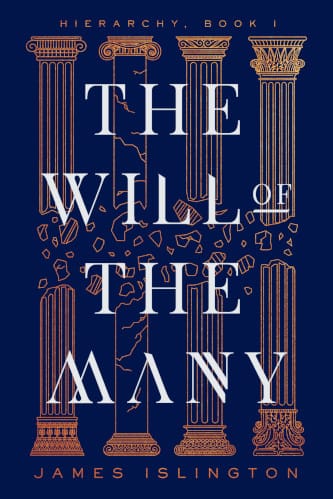
This past week (correction: past couple of days) I tore through James Islington’s Roman-inspired fantasy The Will of the Many. If it sounds familiar, that’s likely because of its recent explosion on bookish social media. Generally, I don’t take too much stock in what circles about there—booktok rarely recommends me things that 1) ARE NOT romance/erotica and 2) I haven’t been exposed to already (ex: how many times will booktok call The Song of Achilles underrated? I read that in high school nearly seven years ago). But, the recent attention reminded me that a former professor recommended this book to me a couple of months ago, so I finally picked it up, and, as previously mentioned, tore through it. Voraciously. Honestly, I don’t think I’ve read something so greedily like this since high school, and I think that’s because The Will of the Many (henceforth WOTM) balanced expectation with some great surprises.
WOTM follows seventeen-year old Vis, a fugitive prince struggling to make ends meet in the Catenan Empire, which has conquered his homeland and orphaned him just three years prior. By day he works as a prison guard for meager wages and by night fights in the Victorum in gladiator-like brawls, throwing bets to supplement his pay but which are garnished by the matron of the orphanage. Beyond being a prince in hiding, Vis is notable because of his inability to cede Will, a life force which is extracted from people in order to power Caten’s infrastructure and, quite literally, its political leaders—the higher up on the hierarchy someone is, the more people they have ceding Will to them, lending them impossible strength and formidable abilities. Yet when a privileged Catenan family spots his fighting prowess, Vis is recruited to infiltrate the prestigious Catenan Academy and uncover the truth behind the suspected murder of Caeror, a former student. As Vis climbs the ranks of the Academy and navigates demands from multiple violent factions, he wrestles with identity, how to act with integrity, and what it means to resist domination.
Seems straightforward, no? Incorrect! WOTM is deceptively complex. Underneath the well-trod plot of evil empires and a coming of age tale is a twisty bloody conspiracy that rivals that of Lost or The X-Files. But even in its over-layer, I couldn’t say that I expected WOTM to combine the orphan plot with dark academia with Roman-inspired fantasy in the way that it did. I was expecting gladiator fights and chariot-races instead of [REDACTED: READ THE BOOK TO FIND OUT]. Not to fear though—there are plenty of unique action beats to scratch that itch. The amotus duel is particularly memorable for its imaginative mechanics, and if you want something more akin to a class-wide battle-royale, the Iudicium has got you covered. Truly this is a novel bursting at the seams with details and history that you barely scratch the surface of, leaving you with many more questions than answers.
Most of these questions are exciting, leaving me pleasantly frustrated at having to wait for the second book, but there are times where these questions are merely frustrating. One of the book’s greatest assets is its streamlined prose—its easy to build reading momentum and immerse yourself in its plot because you don’t have to decipher line by line what something is, what it does, and what it accomplishes. Most of the world building is accessible and rendered clearly. Unfortunately, when important concepts are under-explained, you feel it all the more acutely. It’s most apparent in some of Islington’s world building (no, seriously, why would any of the octavii cede their Will, well, willingly? Do they get anything in return?), in the plot’s connective tissue (why did Vis have to sneak back to Solivagus during the Festival of the Ancestors in the way that he did? Also, which of the ruins was it that Caeror died in?), and even in sentence level exposition. The consequence of streamlined prose is that it’s streamlined prose—descriptions are sparse and basic, working words are many, and this creates ambiguity that worked against the otherwise brilliant immersion. I cannot explain with confidence how Will-imbued transvects work, or even what they look like or how they’re laid out. Hell, I’m not even sure I fully understand how ceding Will works, which is vexing when literal math equations and trigonometry get thrown at Vis explaining this world-governing mechanic in depth.
And I’m not the only one who feels this way. Myriad a reddit thread are arguing the particulars of ceding Will as we speak. Much of this I’m willing to forgive, though. Islington writes with such swagger 90% of the time that I’m assuming these things are ambiguous for a reason, that it’s not necessarily supposed to pass the sniff test. And understand that I wouldn’t be poking at these questions in the first place if I wasn’t hardcore invested in this world and its central conceit. I’m sure some of my questions will be explained when the second book comes out shortly.
Which will surely be in a few months. Just a few.
If there is one detail about WOTM that I can confidently say I don’t appreciate, it would be the way it depicts anti-imperial resistance. Characters discuss complicity at various points in the novel, and without fail, the characters who assimilate—begrudgingly, tragically, or strategically so—into Catenan society are endowed a sense of nuance and humanity that members of the Anguis, a corps of anti-imperial fighters, never receive. Sedotia, one of the Anguis’ key operatives, levels an ultimatum at Vis roughly two-thirds of the way through the novel about how the only way to topple a pyramid is to strike its base;
“You think an Octavus who gives his Will is somehow less responsible than the Sextus who kills with it? The weak and poor endure in the Hierarchy because the alternatives are harder, not because there are none” (Islington 425).
Sedotia walks her talk, for what it’s worth, viscerally so, multiple times throughout the novel. It’s an unforgiving argument, and its implications of downward violence are as uncomfortable as they are grotesque. Grotesque, because the trope of the resistance being just as awful if not more so than the empire is a tiresome one within fantasy, and grotesque because it is uncharitable. I find it suspect that the Anguis, for all their cunning plans and radical ideas of power, never once consider the prospect of manufactured consent as a tool of empire. Islington writes them as transparent hypocrites no less hellbent on wielding power inappropriately than the Catenan Empire, manufacturing them with simple extremity in an otherwise complicated novel. It’s this simple extremity which is depicted far too often in speculative fiction with deleterious effects on how the West figures anti-imperial resistance and those who engage in it in the real world. It’s emblematic of a larger issue, and one which Islington does not effectively subvert.
Vis, as the only character who seeks to remove himself from this system of power entirely, could very well be the counter point. Certainly the ending of the novel provides enough fodder to see all the different ways Vis could react to Catenan power, and it will be fascinating to see if or how he prevails. Only time will tell.
Overall, WOTM is an entertaining read inspired by an era that otherwise goes unexplored in literature, save for Pierce Brown’s Red Rising and Madeline Miller’s retellings. Finishing the book left me speechless, where all those hundreds of pages culminated in a final fifty page avalanche that re-contextualized everything I’d read. Regardless of the creative choices that were dissatisfying to me, the fact of the matter was that I could not put it down. There’s a command of plot and writerly sleight of hand that’s just a blast to lose yourself in. Additionally, it feels like a good bridge between young adult and full on adult genre fiction. It’s got a little bit of everything, so whether you want a bildungsroman, deadly educational settings, or political intrigue, there will be something in here for you. So if you’re willing to haul around a book the size of a door-stopper, take some unexpected twists and turns, and withstand an astounding amount of pyramids within pyramids, consider picking up WOTM. It’ll likely be rewarding, and if you get confused, there are plenty of readers eagerly awaiting to discuss it all with you, which is nearly just as fun as the book itself.
FINAL RATING: 7/10 triangles
The Will of the Many is 640 pages
Thanks for reading Call Me Discontented! Subscribe for free to receive new posts and support my work.